Baby carrier types, and how to carry your baby safely
Carrying your baby close leaves your hands free and often calms the fussiest evenings. The type matters less than the fit, and the fit follows five simple rules.
Updated October 14, 2026 · sources checked October 13, 2026 · Editorial: The Mamavela team
In short
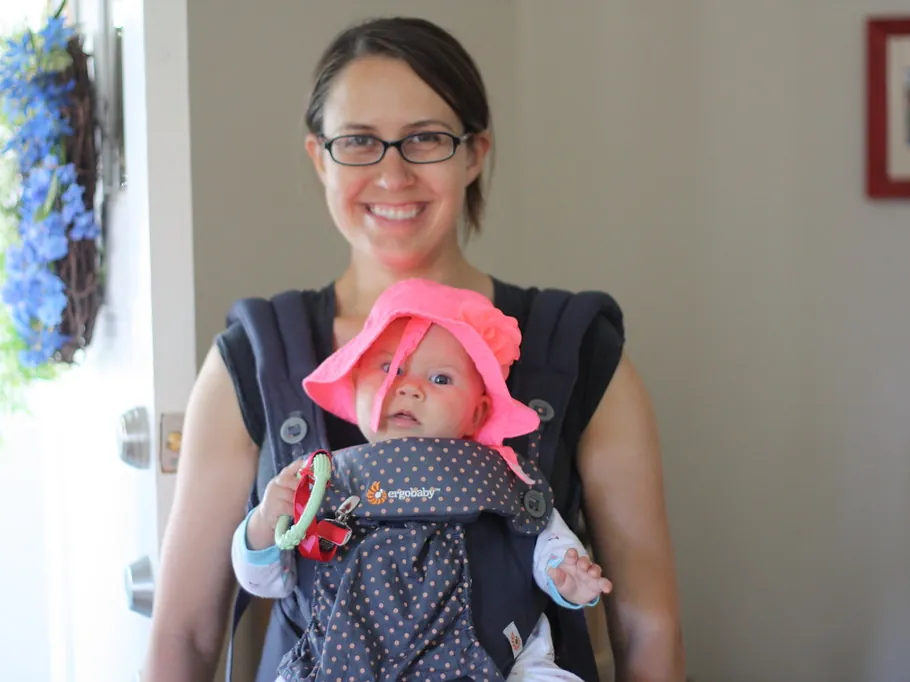
The main baby carrier types are stretchy and woven wraps, ring slings, soft structured (buckle) carriers and framed backpack carriers. Whatever you choose, follow T.I.C.K.S. - tight, in view, close enough to kiss, keep the chin off the chest, supported back - and choose a wide base that supports your baby's thighs to the knees. Back carrying usually waits until about 6 months.
We do not sell baby carriers. This guide explains the types, the rules and the fit, without ranking any brand.
Why parents carry
A 2026 systematic review by Lovell-Kennedy and colleagues (62 studies) found real benefits for babies and caregivers, and parents' main reason for carrying was being responsive to their baby while staying mobile. In an older randomized trial, Hunziker and Barr found that babies who were carried more during the day cried and fussed 43% less at 6 weeks, the usual peak of crying. If evenings are hard, our pages on colic and the PURPLE crying period may help too.
The same review found that rare deaths (mainly from breathing being blocked) and injuries (mainly falls) happened when carriers were poorly fitted or positioned. That is why the fit rules below matter more than the type.
The carrier types at a glance
| Type | What it is | Good for | Watch for |
|---|---|---|---|
| Stretchy wrap | A long piece of soft stretch fabric tied around you | Newborn months, close and snug | Learning the tie; re-tighten as it sags |
| Woven wrap | A long, non-stretch woven fabric | Newborn to toddler, front, hip and back carries | Longest learning curve |
| Ring sling | Fabric threaded through two rings, over one shoulder | Quick ups and downs, hip carries | One-shoulder load; keep baby upright, not cradled |
| Pouch sling | A fabric tube worn over one shoulder | Short carries | Fit must match your size; avoid a deep, curved "C" pocket |
| Soft structured (buckle) carrier | Padded waist belt and shoulder straps with buckles | Easy to put on, shared between partners | Check the seat is wide enough for your baby's size |
| Meh dai (mei tai) | A fabric panel with long straps you tie | Between a wrap and a buckle carrier | Tying technique |
| Framed backpack carrier | A rigid frame worn on the back | Hikes with an older baby who can sit | Back carrying only once your baby is ready (about 6 months, NHS) |
The safety rules: T.I.C.K.S.
The NHS quotes the UK Sling Consortium:
- Tight: tight enough to hug your baby close to your body.
- In view at all times: you can see your baby's face by glancing down.
- Close enough to kiss: your baby's head is high enough to kiss.
- Keep chin off the chest: your baby's chin is not pressed down onto their chest.
- Supported back: your baby's back is supported in a natural, upright position.
RoSPA explains the reason: in a curved, "C-like" position, or with the chin falling onto the chest, a baby's airway can be blocked, and fabric pressed against the nose and mouth can cause suffocation within a minute or two. RoSPA says a carrier that keeps a newborn solidly against your body, in an upright position, is the safest method, and that babies born premature or with a low birth weight need extra care: ask your health visitor, midwife or pediatrician before carrying them.
Hip-healthy carrying
The International Hip Dysplasia Institute recommends a wide-base carrier: one that supports your baby's thighs to the knees, with the hips spread around your body, rather than a narrow base that only supports the crotch. In an ultrasound study by Siddicky and colleagues, babies in a wide-base carrier had their hips held in a position not significantly different from the Pavlik harness used to treat hip dysplasia, while hip coverage was 10 to 12% lower in a narrow-base carrier. The IHDI adds that there is no evidence narrow-base carriers cause hip dysplasia, but the first 6 months are when the hips develop fastest.
Simple check: the fabric or seat reaches from knee to knee, with your baby's thighs supported and legs spread around you rather than hanging straight down. This is the same principle as hip-healthy swaddling.
US safety standards to look for
- Soft structured carriers sold in the US must meet 16 CFR 1226, which incorporates ASTM F2236-24.
- Sling carriers, including ring slings and wraps, must meet 16 CFR 1228, which incorporates ASTM F2907-22. The CPSC describes a sling as fabric construction carrying a child from full-term birth up to 35 pounds, upright or reclined against the caregiver's torso, and its requirements cover structural integrity, restraints and occupant retention, among other points.
Check the label and the instructions for the weight range and the positions the maker allows, and check the model against the CPSC recall list, especially if it is secondhand.
What you really need vs nice-to-have
| Need | Nice-to-have |
|---|---|
| One carrier that keeps your newborn upright, high and snug | A second carrier for a partner of a different size |
| A wide seat supporting the thighs to the knees | Breathable fabric for hot climates |
| Clear instructions and a label with the weight range | A back-carry option for later |
| Buckles, rings and seams in good condition | Lumbar support for longer walks |
Printable checklist before every carry
Is this normal? When to call
Is it normal?
Many babies fall asleep within minutes of being carried. That is normal; just keep checking T.I.C.K.S., and move your baby to a firm, flat sleep surface on their back for a proper nap, as the AAP advises.
For your partner
For the partner
Carrying is one of the most practical ways for a partner to soothe a newborn while the birthing parent rests. Practice the fit together, with a doll or a rolled towel first, and check each other's T.I.C.K.S. before walking out the door.
For your other first-weeks gear, see the stroller types guide, the car seat types guide and the newborn essentials checklist.
Questions parents ask
What does T.I.C.K.S. stand for?
Tight, In view at all times, Close enough to kiss, Keep chin off the chest, Supported back. These are the UK Sling Consortium rules quoted by the NHS and RoSPA.
When can I carry my baby on my back?
The NHS says older babies who can hold up their heads and whose backs are stronger, at about 6 months, can be carried in carriers that go on your back.
Can I breastfeed in a sling?
The NHS says it is not safe to feed your baby while they are in a sling, and RoSPA advises against breast or bottle feeding in a sling. Take your baby out to feed, then put them back upright.
Can my baby sleep in a carrier?
Babies often doze while being carried, so keep checking T.I.C.K.S. The AAP says that if your baby falls asleep in a carrier or sling, move them to a firm, flat sleep surface on their back as soon as possible.
Do you sell baby carriers?
No. We do not sell carriers or slings. This guide describes types and safety points only, so you can choose any carrier that fits you and your baby.
Sources
- NHS — What you'll need for your baby (baby carriers and slings, T.I.C.K.S.) checked October 13, 2026
- RoSPA — Baby sling safety advice checked October 13, 2026
- U.S. CPSC — Sling Carriers business guidance (16 CFR 1228) checked October 13, 2026
- eCFR — 16 CFR Part 1226, Safety Standard for Soft Infant and Toddler Carriers (ASTM F2236-24) checked October 13, 2026
- eCFR — 16 CFR Part 1228, Safety Standard for Sling Carriers (ASTM F2907-22) checked October 13, 2026
- International Hip Dysplasia Institute — Babywearing research confirms hip healthy position in wide-base carriers checked October 13, 2026
- AAP HealthyChildren — How to Keep Your Sleeping Baby Safe, AAP Policy Explained checked October 13, 2026
- NHS — Head injury and concussion checked October 13, 2026
- Siddicky S et al. (2023), Journal of Orthopaedic Research — Ultrasonographic evaluation of infant hips in the Pavlik harness compared to body-worn commercial baby carriers (PMID 37080928) checked October 13, 2026
- Lovell-Kennedy SR et al. (2026), BMJ Paediatrics Open — Safety and benefits of adult-worn slings and baby carriers, a narrative systematic review (PMID 42235974) checked October 13, 2026
- Hunziker UA, Barr RG (1986), Pediatrics — Increased carrying reduces infant crying, a randomized controlled trial (PMID 3517799) checked October 13, 2026
Mamavela explains; it does not replace your midwife, doctor or pediatrician, who know your situation. If something worries you, call them. In an emergency, call 911 (US), 999 (UK) or 112.