Cryptic pregnancy: when you find out late
Finding out you are pregnant months later than you expected is more common than people think, and it is never a personal failure.
Updated October 22, 2026 · sources checked October 13, 2026 · Editorial: The Mamavela team
In short
A cryptic pregnancy is one you do not know about until 20 weeks or later, sometimes until labor. In a Berlin study it happened in about 1 in 475 pregnancies. It usually comes from light or absent symptoms, bleeding that looks like a period, or a test taken too early. If you find out late, book prenatal care right away.
What "cryptic pregnancy" means
"Cryptic pregnancy" is not a medical diagnosis. It is the everyday name for a pregnancy that a woman does not recognize until well into it. Researchers often call it "unrecognized" or "denied" pregnancy. The word denial sounds like a judgment, but in the studies it simply means the pregnancy was not known, by her or by a doctor.
A well-known study from Berlin counted women who did not realize they were pregnant until 20 weeks or later. Some found out at a routine visit for something else, some only when labor began.
How common is it?
More common than its reputation suggests. Between July 1995 and June 1996, researchers asked every maternity hospital in the Berlin area to report these cases (Wessel and Buscher, BMJ 2002):
| Finding | Berlin study |
|---|---|
| Births counted | 29,462 |
| Women unaware of the pregnancy until 20 weeks or later | 62, about 1 in 475 pregnancies |
| Women unaware until they went into labor | about 1 in 2,455 births |
| Comparison given by the authors | finding out only at labor was about 3 times more frequent than triplets |
So if this is happening to you, you are far from alone.
Why a pregnancy can go unnoticed
There is rarely one single reason. Usually several ordinary things line up.
Symptoms are mild, or feel like something else
The NHS says early signs usually start around 4 to 6 weeks, but that not everyone has all of them, and every pregnancy is different. Tiredness, sore breasts, mood changes or more discharge are easy to put down to stress, a busy month or your usual cycle. Our early signs of pregnancy page lists the 12 signs the NHS describes.
Bleeding that looks like a period
The NHS lists "a bleed similar to a very light period" around the time your period is due as a possible sign of pregnancy (implantation bleeding). ACOG adds that bleeding happens in 15 to 25 in 100 pregnancies in the first trimester, and that the cervix can bleed more easily in pregnancy, for example after sex. If you have always had irregular periods, a lighter or late bleed can feel like nothing new.
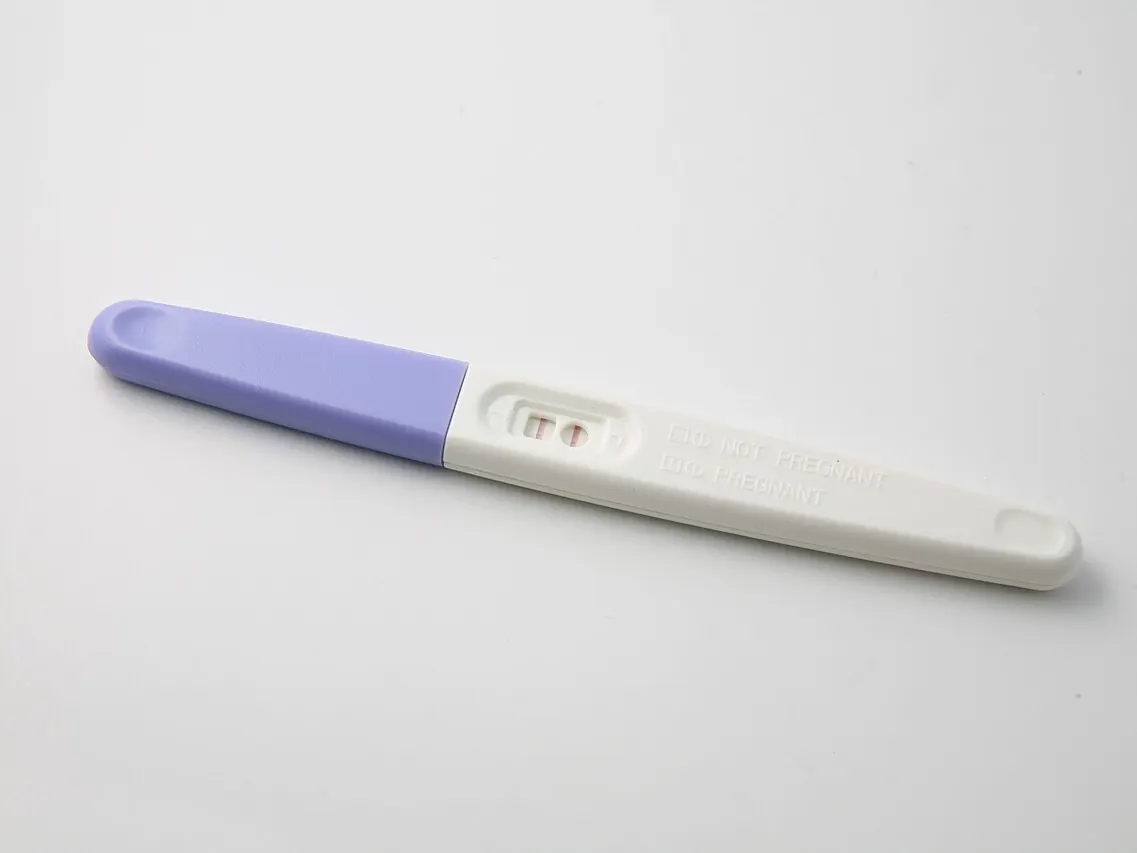
A test taken too early, or read too fast
- A pregnancy cannot be detected before the embryo implants. In a study of 136 pregnancies, 10% had not yet implanted on the first day of the missed period, so even a very sensitive test could not have picked them up that day (Wilcox et al., JAMA 2001).
- The NHS says a positive result is almost certainly correct, but a negative result is less reliable, especially if the test was done too early or without following the instructions.
- MedlinePlus explains that drinking a lot of fluid before testing can dilute the hormone the test looks for (hCG).
"I'm on contraception"
The NHS reminds that no method of contraception is completely effective, and that hormonal contraception does not stop a pregnancy test working. If you have symptoms, a test is still worth doing.
Signs that are worth a test, even now
If any of these sound familiar, a home test costs little and settles the question:
- a period that was lighter, shorter or "different" from usual, or none at all;
- unexplained tiredness, nausea, or new food cravings or dislikes;
- breasts that feel larger or tender;
- needing to pee more often, without pain;
- more vaginal discharge without itching or soreness;
- a growing belly, or movements you cannot explain.
MedlinePlus advises testing with your first morning urine and following the timing in the instructions. If the result is negative but you still feel pregnant, test again a week later. If two tests are negative and your period has not come, see your doctor: a blood test can detect very small amounts of hCG, and an ultrasound can show how far along you are.
You just found out: what to do in the next few days
Finding out late can bring shock, joy, fear, guilt, or all of these at once. All of it is normal. Then, one step at a time:
Why speed matters: in the Berlin data, babies born after an unrecognized pregnancy had higher rates of preterm birth, low birth weight and admission to neonatal care than other births (Wessel et al., 2003). The authors link this mainly to missing or late prenatal care, which is exactly what you can change from today.
If you are not sure you want to continue the pregnancy, the NHS says you can talk it through confidentially with a doctor or nurse, and that your options include continuing with the pregnancy, adoption or abortion. In the US, your doctor or a local health department can tell you what is available in your state.
Is it normal?
Is this normal? Feeling guilty for "not noticing" is very common, and it is not deserved. Bodies, cycles and symptoms vary a lot, and tests have real limits. What matters now is getting care.
Is this normal? When to call
If you are past 20 weeks, read the signs of labor so you know what to watch for, and keep your notes or test results with you.
For your partner
The news may land on you just as suddenly. Go to the first appointment together if she wants you there, take over the practical side (calls, forms, insurance), and avoid "how did you not know?". She is probably asking herself that already.
Questions parents ask
Can you have a period and still be pregnant?
Not a true period, but bleeding can happen. The NHS describes implantation bleeding as a bleed similar to a very light period around the time your period is due, and ACOG says bleeding happens in 15 to 25 in 100 first-trimester pregnancies. Any bleeding in pregnancy deserves a call to your doctor or midwife.
Can a pregnancy test be negative in a cryptic pregnancy?
A test taken too early, or not used as the instructions say, can miss a pregnancy. The NHS says a negative result is less reliable than a positive one. If you still think you are pregnant, test again a few days to a week later and see your doctor if your period has not come.
How common is cryptic pregnancy?
In a year-long study covering all births in Berlin, about 1 in 475 women did not know they were pregnant until 20 weeks or later, and about 1 in 2,455 did not find out until labor (Wessel and Buscher, BMJ 2002).
Is a cryptic pregnancy dangerous for the baby?
The pregnancy itself is not different, but late or missing prenatal care matters. In the Berlin study, babies born after an unrecognized pregnancy had higher rates of preterm birth and low birth weight than other births. Starting care as soon as you know is what helps most.
Sources
- NHS — Signs and symptoms that might mean you're pregnant checked October 13, 2026
- NHS — Doing a pregnancy test checked October 13, 2026
- MedlinePlus (NIH) — Pregnancy test checked October 13, 2026
- ACOG — Bleeding during pregnancy (FAQ) checked October 13, 2026
- Wessel J, Buscher U (2002), BMJ — Denial of pregnancy: population based study (PMID 11859048) checked October 13, 2026
- Wessel J et al. (2003), Journal of Perinatal Medicine — Elevated risk for neonatal outcome following denial of pregnancy (PMID 12661141) checked October 13, 2026
- Wilcox AJ et al. (2001), JAMA — Natural limits of pregnancy testing in relation to the expected menstrual period (PMID 11594902) checked October 13, 2026
Mamavela explains; it does not replace your midwife, doctor or pediatrician, who know your situation. If something worries you, call them. In an emergency, call 911 (US), 999 (UK) or 112.