When to take a pregnancy test: your test date calculator
Waiting is the hardest part. Give the calculator the first day of your last period and your usual cycle, or just the date you had unprotected sex, and it gives you three dates: the earliest, the reliable one and the surest one.
Updated October 14, 2026 · sources checked October 14, 2026 · Editorial: The Mamavela team
In short
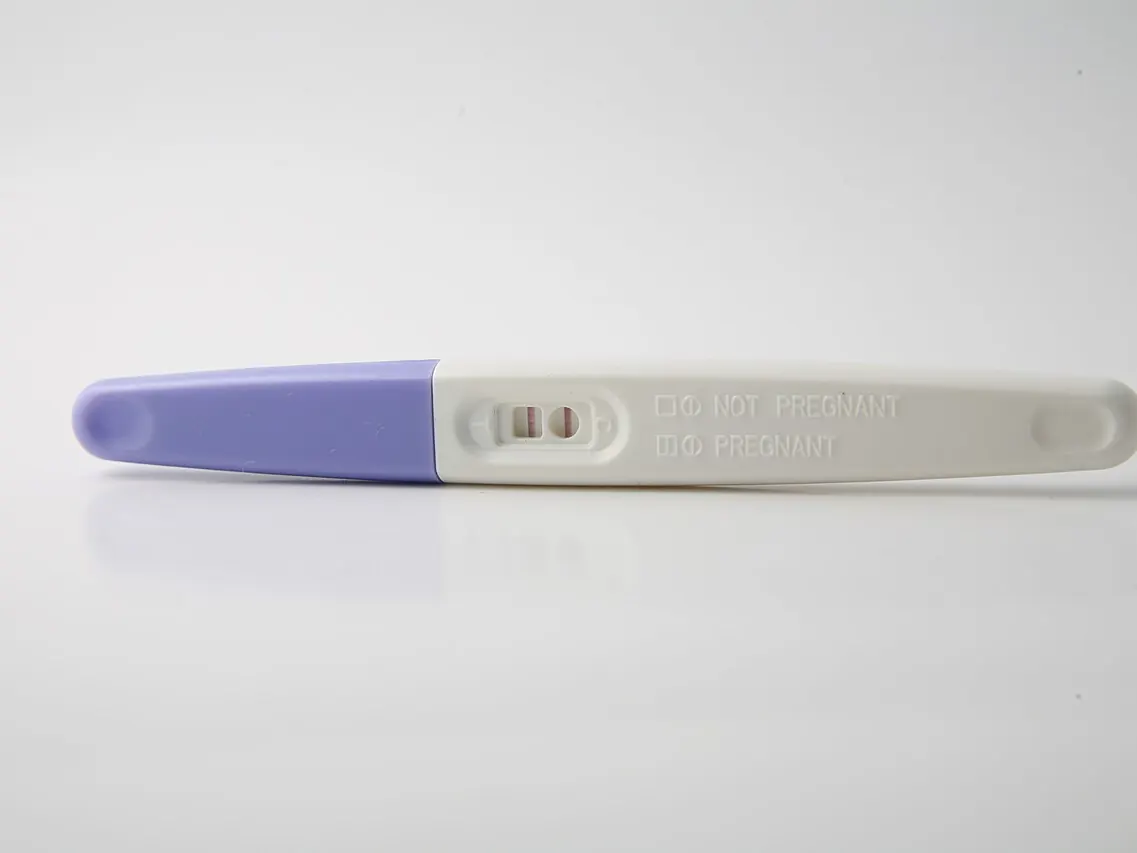
Take a home pregnancy test from the first day of your missed period: that is when most tests are reliable. If you do not know when your period is due, test at least 21 days after unprotected sex. For the most reliable result, the FDA advises testing 1 to 2 weeks after the missed period. A negative test before then is not final.
How the calculator finds your test date
A pregnancy test looks for hCG, a hormone made once the embryo has implanted. The NHS says it starts to be produced around 6 days after fertilization. The calculator works back from the moment hCG can be found in urine:
| You enter | The calculator does | Why |
|---|---|---|
| First day of your last period + usual cycle | Period due = that day + cycle length | Most tests are reliable from the first day of the missed period (NHS) |
| The same | Ovulation ≈ 14 days before the period due | Earliest hCG in urine: 6 to 12 days after ovulation (Wilcox 1999) |
| The same | Surest result = 1 to 2 weeks after the missed period | FDA advice for the most reliable result |
| Only the date of unprotected sex | That date + 21 days | NHS rule when you do not know when your period is due |
Example: last period started on 3 November, 28-day cycle. Your period is due on 1 December, which is the day a test becomes reliable. Ovulation was probably around 17 November, so a very sensitive test might react between 23 and 29 November, and the surest window runs from 8 to 15 December. With a 35-day cycle and the same start date, every date moves 7 days later: period due on 8 December.
What your test date can and cannot tell you
- It tells you when a negative result starts to mean something. Before the period is due, many pregnancies are not detectable yet. In the reference study by Wilcox et al. (1999), hCG first appeared in urine 6 to 12 days after ovulation, and between day 8 and day 10 for 84 % of the pregnancies that continued.
- It cannot tell you how sensitive your test is. Tests do not all detect the same amount of hormone. When Cole et al. (2004) compared 18 brands, a sensitivity of 12.5 mIU/mL was needed to catch 95 % of pregnancies on the day of the missed period, and only 1 brand out of 18 reached it. A test that needs 100 mIU/mL would catch only about 16 % of pregnancies at that point.
- It is not a result. A positive test is almost certainly right, the NHS says; a negative one is less reliable. The FDA calls an early negative a tentative finding.
Is it normal?
A negative test on the day your period is due, and still no period? That is common: you may have ovulated later than you think. Test again a few days later. If the second test is negative and your period has still not come, talk to your doctor or midwife (NHS).
Special situations
- Irregular or long cycles. Ovulation moves with your cycle, so the calculator places it 14 days before the period due. If your cycles vary, enter the longest one: you will lose a few days, not a pregnancy. If you cannot predict your period at all, use the date-of-sex option.
- After IVF or fertility treatment. Do not use this calculator. Your clinic gives you a test date and the HFEA advises not to test early, as you may get a false result. Some fertility treatments use hCG injections (Cleveland Clinic): ask your clinic how this affects your test date.
- After a birth, while breastfeeding, or just after stopping contraception. If your periods have not come back or are not regular yet, there is no reliable date to count from. Use the date-of-sex option: 21 days after unprotected sex is the NHS rule when you do not know when your period is due.
- Medicines. The NHS notes that some medicines can affect the result. If you are unsure, ask a pharmacist before reading too much into a negative.
When to call
Call your doctor, midwife or emergency services without waiting if you might be pregnant and have pain low down on one side of your tummy, pain in the tip of your shoulder, bleeding, or feel faint. The NHS says to seek help even if your pregnancy test is negative: these can be signs of an ectopic pregnancy.
Your test is positive: next steps
- Due date calculator, from the same last period date.
- How many weeks pregnant am I?
- When did I conceive?
- 4 weeks pregnant: where you are on the day the test turns positive.
- Early signs of pregnancy
- Had a blood test? The hCG levels by week page shows the ranges and the change between two results.
- Trying again next month? The ovulation calculator shows your fertile days.
Questions parents ask
How many days after a missed period should I take a pregnancy test?
You can test on the first day of the missed period; the NHS says most tests are reliable from then. The FDA notes that 10 to 20 pregnant women out of 100 still test negative that day, and advises testing 1 to 2 weeks after the missed period for the most reliable result.
How soon after sex can I take a pregnancy test?
If you know when your period is due, wait for that day. If you do not, the NHS advises testing at least 21 days after the unprotected sex. Testing a few days after sex cannot work: the pregnancy hormone only starts to be made after implantation.
Can I take a pregnancy test before my missed period?
Some very sensitive tests can react a few days before, but a negative result then means nothing yet. In the Wilcox study, the hormone first appeared in urine 6 to 12 days after ovulation, so for some women it is simply not there yet before the period is due.
My cycle is irregular. When should I test?
Enter your longest usual cycle in the calculator, or switch to the date-of-sex option: 21 days after unprotected sex is the NHS rule when you cannot predict your period. If the test is negative and your period still has not come, test again a few days later.
Is first morning urine better for a pregnancy test?
The FDA says using your first morning urine can improve your chances of an accurate result, because it is the most concentrated. From a few days after the missed period, most tests work at any time of day, but read the leaflet of your brand.
When should I take a pregnancy test after IVF?
On the date your clinic gives you, not before. The HFEA warns that testing early after embryo transfer can give a false result, so this calculator is not meant for IVF cycles.
Sources
- NHS — Doing a pregnancy test checked October 14, 2026
- NHS — Ectopic pregnancy checked October 14, 2026
- FDA — Pregnancy (home-use tests) checked October 14, 2026
- Wilcox AJ, Baird DD, Weinberg CR, Time of implantation of the conceptus and loss of pregnancy, N Engl J Med 1999 (DOI 10.1056/NEJM199906103402304, PMID 10362823) checked October 14, 2026
- Cole LA et al., Accuracy of home pregnancy tests at the time of missed menses, Am J Obstet Gynecol 2004 (DOI 10.1016/j.ajog.2003.08.043, PMID 14749643) checked October 14, 2026
- Cleveland Clinic — Human Chorionic Gonadotropin (hCG) checked October 14, 2026
- HFEA — In vitro fertilisation (IVF) checked October 14, 2026
Mamavela explains; it does not replace your midwife, doctor or pediatrician, who know your situation. If something worries you, call them. In an emergency, call 911 (US), 999 (UK) or 112.