Birth center or hospital: what really changes
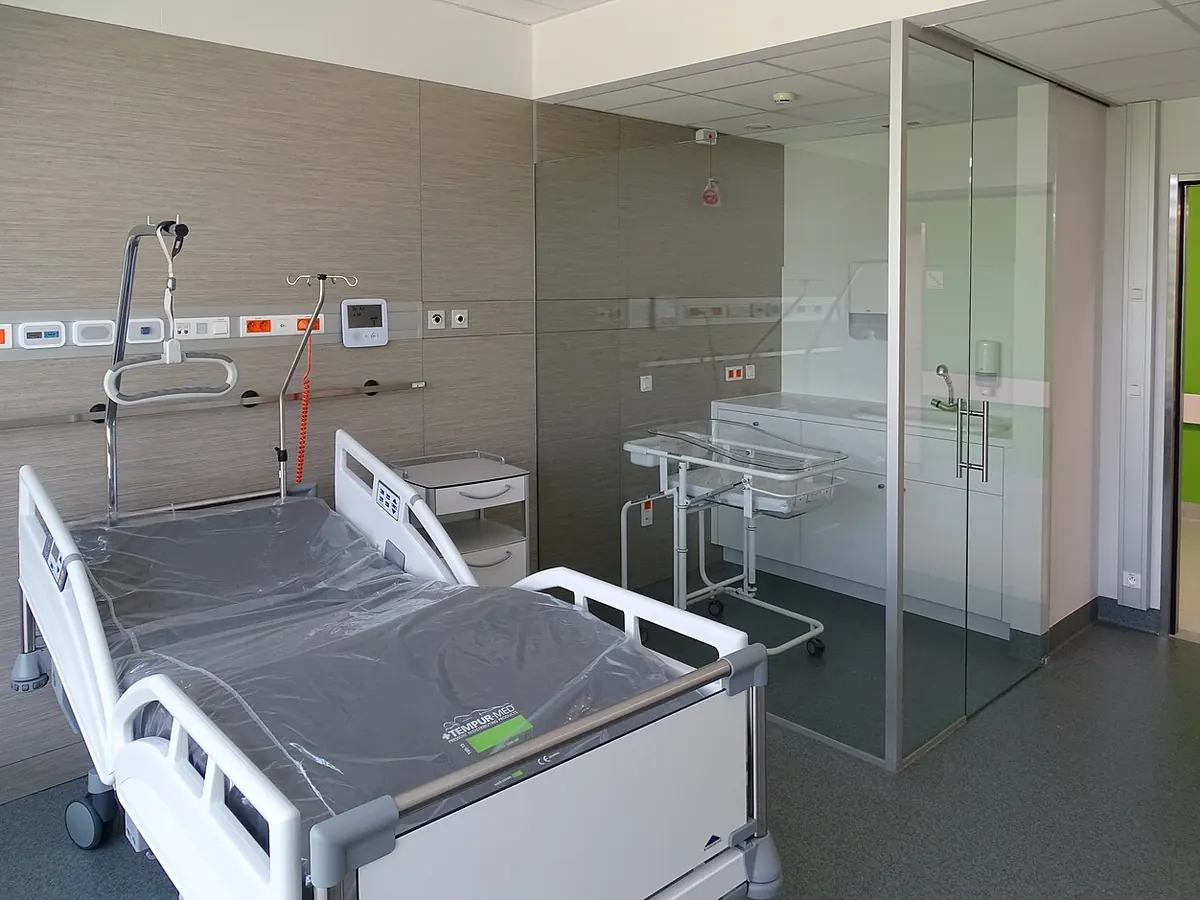
A birth center feels like a bedroom and is run by midwives. A hospital has every specialist on call. Neither is the better choice in general: the right one depends on your pregnancy and on what you want around you.
Updated October 14, 2026 · sources checked October 14, 2026 · Editorial: The Mamavela team

In short
A birth center is a home-like, midwife-led place for healthy women with low-risk pregnancies; there is no epidural or operating room on site, so you move to a hospital if needed. In the US National Birth Center Study II, 84% of women who started labor there gave birth there and 6% had a cesarean. A hospital suits every pregnancy and is the plan if yours is high risk.
Birth center or hospital at a glance
| Freestanding birth center | Hospital labor and delivery | |
|---|---|---|
| Who leads your care | Midwives (certified nurse-midwives or certified professional midwives, according to AABC) | Obstetricians and midwives, with anesthesiologists and pediatric teams |
| Who can give birth there | Healthy women with a low-risk pregnancy, one baby, head down, at term | Everyone, including high-risk pregnancies |
| Pain relief | Water, movement, massage, breathing; ask what else is offered; no epidural | Every option, including epidural around the clock in most units |
| If something changes | Transfer to the partner hospital | Care on site; transfer only if a higher level of care is needed |
Who can give birth in a birth center
Birth centers accept women whose pregnancy stays low risk. The NICE list of conditions gives a good picture of what moves the plan to a hospital: twins, a breech baby, a previous cesarean, pre-eclampsia, diabetes on medication, preterm labor before 37 weeks. Each center has its own written criteria, so ask for them at your first visit, and ask again in the third trimester, because eligibility is checked all the way to labor.
What the studies show
- United States, National Birth Center Study II (Stapleton et al., 2013): 15,574 women in 79 midwife-led birth centers in 33 states. 84% gave birth at the center, 4% were transferred before admission and 12% during labor. Whatever the place of birth, 93% had a spontaneous vaginal birth and 6% a cesarean. Only 1.9% of mothers or babies needed an emergency transfer, and there were no maternal deaths.
- Cochrane review, hospital birth centers (Hodnett et al., 2012, 10 trials, 11,795 women): a home-like setting was linked with fewer epidurals, less oxytocin to speed up labor, fewer episiotomies and instrumental births, more spontaneous births and much more positive views of care, with no apparent effect on other outcomes for mothers or babies.
- England, Birthplace study (2011): for low-risk women, outcomes for babies were the same in freestanding or alongside midwifery units as on the labor ward, with fewer interventions.
Studies like these compare low-risk women, so their results apply to you only while your pregnancy stays low risk.
Transfers: how they work
A transfer is part of the plan, not a failure. The most common reason is a long labor, or wanting an epidural. Before you sign up, ask:
What a birth center costs
- No official national price exists. Ask for a written estimate covering prenatal visits, the birth, the newborn exam and postpartum visits, and what happens to the bill if you transfer.
- With private insurance: check that both the center and its midwives are in network, and how your deductible applies. Our page on the cost of having a baby in the US explains deductibles and the out-of-pocket maximum.
- With Medicaid: CMS explains that states which license or recognize freestanding birth centers must cover their facility services. In the CMS Strong Start evaluation of Medicaid patients, birth center participants had costs $2,010 lower on average per mother and baby from birth through the first year, a preterm birth rate of 6.3% against 8.5% and a cesarean rate of 17.5% against 29% in a risk-matched group. These women were not randomly assigned, so part of the difference may come from who chooses a birth center.
Not near a birth center?
March of Dimes counts 421 accredited birth centers in the US, present in only 8.4% of counties, mostly in a handful of states. If none is within reach, ask your hospital whether it has a midwife-led team, a birth pool or a "low-intervention" room, and write your preferences in your birth plan.
In the UK: midwifery units
The NHS calls them midwifery units or birth centres. An alongside unit sits on a hospital site, with obstetric, newborn and anaesthetic care nearby; a freestanding unit is separate. In a freestanding unit you cannot have an epidural. Ask your midwife which units serve your area: see booking your maternity unit.
Questions parents ask
How much does a birthing center cost?
There is no official national price. Ask the center for a written global fee (prenatal visits, birth, postpartum) and check whether it is in your insurance network. In a CMS evaluation of Medicaid patients, birth center care cost $2,010 less on average per mother and baby, from birth through the first year.
Does Medicaid cover birth centers?
Under the Affordable Care Act, states that license or recognize freestanding birth centers must cover their facility services under Medicaid, CMS explains. Ask the center whether it accepts your state's Medicaid or managed care plan.
Can I get an epidural at a birth center?
Not in a freestanding birth center: an epidural means transferring to a hospital. In a midwife-led unit inside a hospital, the labor ward is close by.
How many women transfer from a birth center to hospital?
In the US National Birth Center Study II, 4% transferred before admission and 12% during labor, most of them without emergency. In England, transfer rates for a first baby were higher, around 36% from freestanding units, often for a slow labor.
Sources
- Stapleton SR, Osborne C, Illuzzi J. Outcomes of care in birth centers: demonstration of a durable model. J Midwifery Womens Health 2013 (PMID 23363029, DOI 10.1111/jmwh.12003) checked October 14, 2026
- Hodnett ED, Downe S, Walsh D. Alternative versus conventional institutional settings for birth. Cochrane 2012 (PMID 22895914, DOI 10.1002/14651858.CD000012.pub4) checked October 14, 2026
- March of Dimes PeriStats — Birth settings in the United States (421 accredited birth centers, 0.6% of births in 2024) checked October 14, 2026
- CMS — Informational Bulletin, Strong Start for Mothers and Newborns evaluation and Medicaid coverage of freestanding birth centers (November 9, 2018) checked October 14, 2026
- NHS — Where to give birth: the options (midwifery units or birth centres) checked October 14, 2026
- Commission for the Accreditation of Birth Centers — find accredited freestanding birth centers and alongside midwifery units checked October 14, 2026
- American Association of Birth Centers — What is a birth center? checked October 14, 2026
Mamavela explains; it does not replace your midwife, doctor or pediatrician, who know your situation. If something worries you, call them. In an emergency, call 911 (US), 999 (UK) or 112.