Pregnancy test: how soon, how accurate, what next
The two-week wait feels endless. Here is what the hormone timeline really allows, and how to get a result you can trust.
Updated October 24, 2026 · sources checked October 13, 2026 · Editorial: The Mamavela team
In short
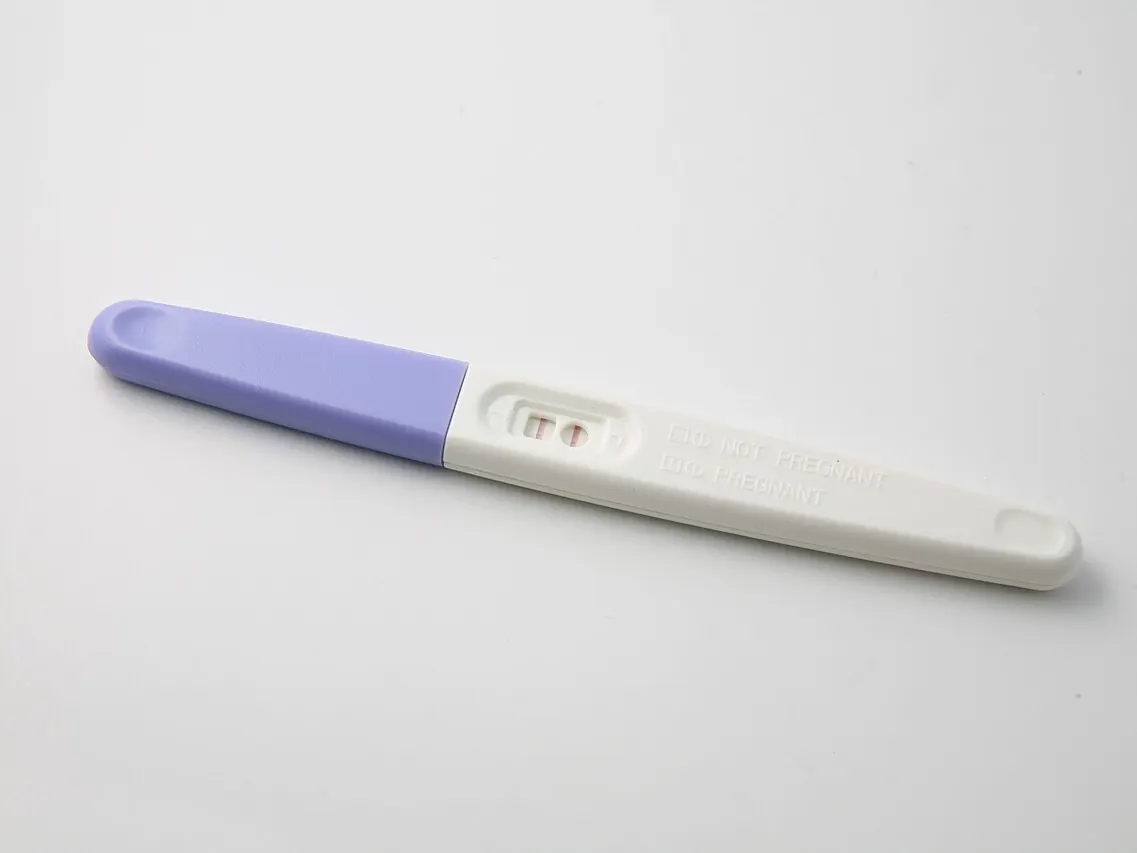
Most home pregnancy tests work from the first day of a missed period. A test can only turn positive after implantation, usually 8 to 10 days after ovulation, so testing earlier often gives a false negative. If you do not know when your period is due, test at least 21 days after unprotected sex. A positive result is almost always right.
How a pregnancy test works
All pregnancy tests look for one hormone, hCG (human chorionic gonadotropin). MedlinePlus explains that the placenta starts making it once a fertilized egg attaches to the wall of the uterus, and that levels then almost double every three days in early pregnancy. The NHS says hCG starts to be produced around 6 days after fertilization.
That is the key point: no test can detect a pregnancy before implantation, however sensitive it is.
The timeline, day by day
Counting from ovulation (for many people, about 14 days before the next period):
| Days after ovulation | What is happening | What a home test can do |
|---|---|---|
| 0 to 5 | Fertilization, the embryo travels to the uterus | Nothing to detect yet |
| 6 to 12 | Implantation; in most successful pregnancies on day 8, 9 or 10 | hCG starts to appear, at very low levels |
| About 14 (first day of the missed period) | hCG is rising | Most tests are designed to work from here |
| About 21 (a week after the missed period) | hCG is clearly higher | Results are the most reliable |
Implantation timing comes from a study that followed 221 women with daily urine samples: in pregnancies that continued, hCG first appeared 6 to 12 days after ovulation, and 84% implanted on day 8, 9 or 10 (Wilcox et al., NEJM 1999).
How soon can a test read positive?
- From the first day of a missed period for most tests (NHS).
- A few days earlier with "early result" tests: the NHS says some very sensitive tests can be used before a missed period, but taking a test too early is one of the reasons it gives for an unreliable result.
- At least 21 days after unprotected sex if you do not know when your period is due (NHS).
Even on the day your period is due, not every pregnancy can show yet. Using an extremely sensitive lab assay, researchers found that 10% of pregnancies had not implanted by the first day of the missed period, so the highest possible sensitivity that day was about 90%, rising to about 97% one week later (Wilcox et al., JAMA 2001). Home tests can only do as well as this, or less.
How accurate are home tests?
MedlinePlus puts urine tests at 97 to 99% accurate when done a week or two after a missed period. The NHS adds two practical rules:
| Result | How much to trust it | Why |
|---|---|---|
| Positive | Almost certainly correct (NHS) | A test can only react to hCG, which is made in pregnancy. Rare exceptions: some fertility medicines, and rare conditions that raise hCG (MedlinePlus) |
| Negative | Less reliable (NHS) | Usually tested too early, diluted urine, or instructions not followed |
Get a result you can trust: checklist
Good to know
A faint line? Read the leaflet of your test on what counts as positive. If you are unsure, test again two or three days later: because hCG nearly doubles every three days early on, a true positive usually gets clearer.
Where to get a test
Home tests are sold in pharmacies and supermarkets, without a prescription. In the UK, the NHS says you may get one free from your GP, sexual health services, some young people's services (national sexual health helpline 0300 123 7123) or Brook centres for under-25s.
After IVF or fertility treatment
Follow your clinic's date. The NHS says you will be given a test and a date to use it, around 16 days after embryo transfer, and that testing on that date gives an accurate result. MedlinePlus warns that some fertility medicines can cause a false positive: if your result surprises you, ask the clinic to confirm it.
You got a positive result: next steps
If you are not sure you want to continue the pregnancy, the NHS says you can talk confidentially with a GP, nurse or sexual health service about all your options.
Is it normal?
Is this normal? A positive test followed by a period a few days later can happen. In the 1999 study above, sensitive lab testing found that 1 in 4 conceptions ended in a very early loss, often before anyone would have known. It is not caused by anything you did. Our page on miscarriage explains the signs and when to call.
When to call
The NHS also advises seeing your GP or doctor if a second test is negative and your period still has not arrived. And if you have symptoms but tests keep coming back negative, read about cryptic pregnancy.
For your partner
Waiting for a result is stressful for both of you. Agree beforehand how you want to read it (together or not), and plan something kind for afterwards, whatever the result.
Questions parents ask
Can I take a pregnancy test at night?
Yes. The NHS says you can test on urine collected at any time of day. MedlinePlus notes that first morning urine usually contains more hCG, so if you are testing early, morning is a little more sensitive. Avoid drinking a lot right before.
Does the pill or other contraception affect the result?
No. The NHS says the hormones in contraception do not stop a pregnancy test working. Fertility medicines that contain hCG can, which is why IVF clinics give you a set test date.
I got a negative test but my period is late. What now?
Wait a few days and test again; MedlinePlus suggests repeating a week later because hCG rises daily in early pregnancy. If a second test is negative and your period still has not come, see your doctor or GP.
Are blood tests more sensitive than home tests?
Yes. MedlinePlus says blood tests can find very small amounts of hCG, before a missed period, but they are slower and rarely needed just to confirm a pregnancy.
Sources
- NHS — Doing a pregnancy test checked October 13, 2026
- MedlinePlus (NIH) — Pregnancy test checked October 13, 2026
- NHS — Ectopic pregnancy checked October 13, 2026
- NHS — IVF, finding out if you're pregnant checked October 13, 2026
- Wilcox AJ et al. (1999), New England Journal of Medicine — Time of implantation of the conceptus and loss of pregnancy (PMID 10362823) checked October 13, 2026
- Wilcox AJ et al. (2001), JAMA — Natural limits of pregnancy testing in relation to the expected menstrual period (PMID 11594902) checked October 13, 2026
Mamavela explains; it does not replace your midwife, doctor or pediatrician, who know your situation. If something worries you, call them. In an emergency, call 911 (US), 999 (UK) or 112.